
















 As the advertising and marketing industry rushes towards an unknown and uncertain AI future, former advertising boss Sarah McDevitt writes about the importance of relational intelligence — the uniquely human ability to build trust, read between the lines, and create meaningful connections in an increasingly automated world.
For the last two years, every conversation in business has revolved around the same question: how quickly can we adopt AI?
Businesses are automating workflows. Marketing teams are replacing manual tasks with AI-powered systems. Content is being generated in seconds. Client reporting is becoming automated. Meetings are summarized before we’ve even left the room. Across every sector, speed and efficiency have become the obsession. And yet, as we race towards this AI-powered future, I believe we’re in danger of forgetting the very thing that made those businesses valuable in the first place: humans.
Understanding People
I started my career in advertising over twenty years ago, working with difficult clients, impossible deadlines, and tiny budgets. What quickly became obvious to me was that the best account managers weren’t necessarily the smartest people in the room or the most technically skilled. They were the people who understood other people.
They could sense when a client was anxious, even when the brief looked straightforward. They knew when a “small change” was really a symptom of deeper uncertainty. They understood how to calm tensions in a room, navigate personalities, and build trust over time. They weren’t just managing campaigns — they were managing human relationships.
Today, AI can do many of the technical parts of our jobs faster than we can. It can analyze data, generate content, optimize ads, and automate reporting. Soon, much of the operational work we once considered valuable will become standard. But AI still cannot truly understand people.
It cannot feel emotional nuance. It cannot instinctively know when someone feels unheard. It cannot build genuine trust. It cannot sit in discomfort, navigate complex human dynamics, or make values-based judgments in the way humans can. And that matters because business has never really been about transactions. It’s about relationships.
Clients stay loyal to agencies because they trust the people inside them. Employees stay in companies because they feel seen, valued, and connected. Customers return to brands because they feel understood. The organizations that thrive over the next decade will not simply be the most technologically advanced — they will be the ones that combine AI capability with deep human connection. This is where relational intelligence becomes critical.
Relational intelligence for me is the ability to understand people beyond surface-level communication. It’s the skill of reading the room, noticing what isn’t being said, adapting your communication style, building trust, and creating an authentic human connection. For decades, we dismissed these as “soft skills.” In reality, they are becoming the hardest skills to replicate. Ironically, AI is making human skills more valuable, not less.
As automation handles more routine work, the real differentiator becomes the ability to bring humanity into environments increasingly shaped by systems and algorithms. The future advantage will belong to people who can connect, empathize, collaborate, and navigate emotional complexity. We’re already seeing this play out in the workplace.
The companies rushing towards “ruthless automation” often discover something surprising: efficiency alone does not create loyalty. Customers become frustrated when every interaction feels transactional. Employees burn out when organizations optimize away human connection in pursuit of productivity. Teams struggle when communication becomes entirely digital and functional.
Meanwhile, the organizations that succeed are using AI differently. They use automation to create more time for meaningful conversations. They use technology to support human relationships, not replace them. They understand that while AI can process information, humans create trust. This shift also requires us to rethink leadership.
When I speak to companies and help them shape their future, they understand that the leaders of the future won’t simply be process managers or efficiency experts. They will need emotional awareness, empathy, communication skills, and the ability to create psychological safety in increasingly uncertain environments. They will need to understand not just systems, but people. Perhaps most importantly, we need to rethink what we teach the next generation.
For years, education and business rewarded speed, standardization, and measurable outputs. But in an AI-first world, those are exactly the things machines will increasingly handle. The skills that will matter most are the deeply human ones: creativity, empathy, ethical judgment, collaboration, storytelling, and relationship-building. We are entering a moment where humanity itself becomes a competitive advantage.
AI is not the enemy. In fact, it has the potential to amplify us in extraordinary ways. But only if we remain intentional about protecting and developing the human capabilities that technology cannot replace. The future of business cannot simply be efficient. It must also be human.
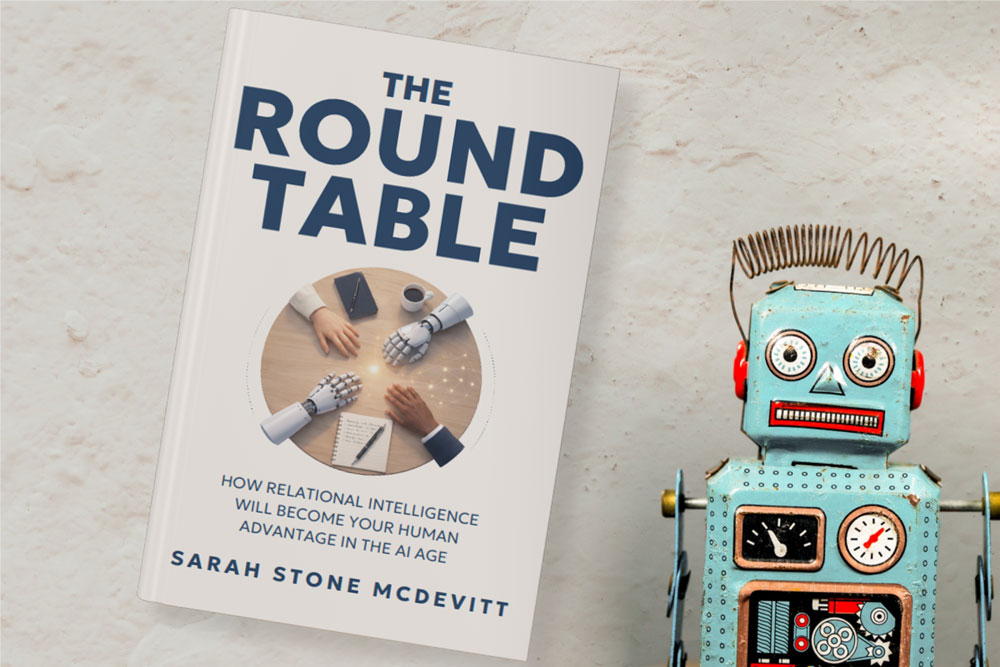
Sarah Stone McDevitt is the author of The Round Table: How Relational Intelligence Will Become Your Human Advantage in the AI Age, available now on Amazon print from June 8th. https://amzn.eu/d/0enEnLsn Ebook Available Now.