

















 Irish brands may be getting better at delivering efficient customer service, but are they losing the human touch in the process? John McGee examines new research from Ipsos B&A which suggests that customer experience (CX) is entering an “Age of Beige”, with significant implications for brand loyalty, differentiation and growth.
New research from Ipsos B&A paints a sobering picture of customer experience in Ireland, revealing that while companies have become increasingly efficient at delivering basic services, they are failing to create the emotional connections that drive loyalty, advocacy and long-term growth.
In addition, with artificial intelligence reshaping customer interactions and consumers under growing financial pressure, the research suggests that brands face a fundamental challenge: how to become more human in an increasingly automated world.
“The CX Irish Insights 2026” research is based on 1,491 customer evaluations across seven sectors and was written by Ipsos B&A’s in-house CX experts, Clare Kavanagh, Deirdre Kelly and Caoimhe MacGabhann.
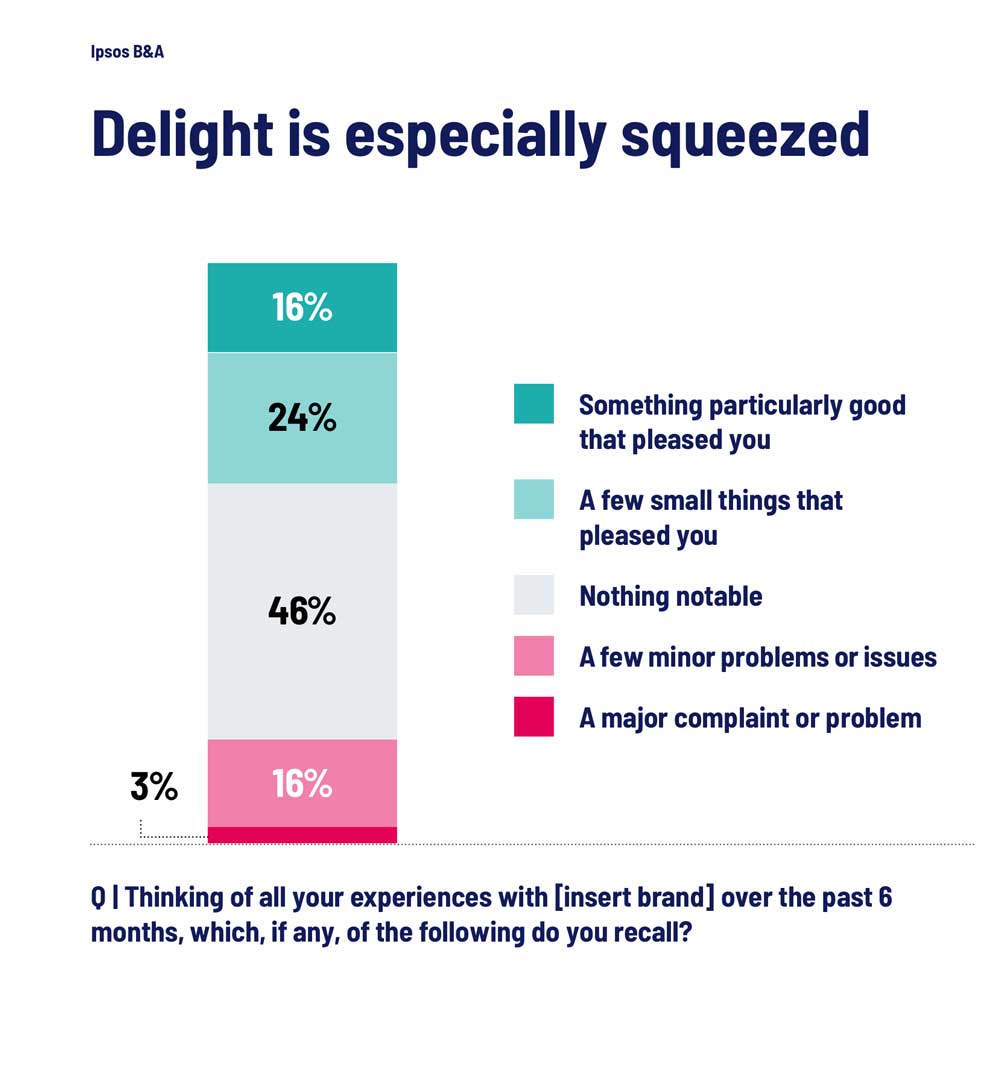
One of the key findings of the research is that almost half (46%) of customer experiences are considered unremarkable, while just 16% involve something positive that delights the customer.
The findings point to what the Ipsos B&A researchers describe as the “Age of Beige”, a marketplace in which operational efficiency and automation have improved service delivery but have also contributed to increasingly generic and emotionally uninspiring customer experiences.
For marketers, the implications are significant. At a time when brands are investing heavily in technology, personalisation and AI, the research suggests that much of this investment is failing to translate into meaningful customer relationships.
Perhaps most tellingly, 49% of consumers say their actual experience with a brand is more important in influencing their choice than its image (30%). Meanwhile, 45% say they are willing to pay more for a better customer experience.
These findings reinforce the commercial importance of CX as a source of competitive advantage says Ipsos B&A.
The growing experience gap
According to the research, Irish businesses have made considerable progress in eliminating negative experiences and improving basic service delivery. However, removing dissatisfaction is not the same as creating satisfaction, and delivering an efficient service does not necessarily encourage loyalty, the research notes.
While 40% of respondents recall positive experiences, just 16% remember something particularly good while another 24% can recall small positive moments.
The distinction is important, according to Ipsos B&A.
While brands have become better at eliminating friction, simplifying transactions and introducing automated processes, these are now viewed as basic consumer expectations rather than reasons to choose one brand over another.
When it comes to a sectoral view of CX, Ipsos B&A notes that there are substantial differences between sectors.
Supermarkets, for example, emerge as comparatively strong performers, with 30% of consumers recalling small positive experiences and 18% reporting particularly pleasing interactions.
Unfortunately for utility companies like electricity and gas suppliers, their CX performance leaves a lot to be desired with some 59% of their customers report nothing notable about their experience, while just 9% recall something particularly positive.
Airlines and insurers also struggle to differentiate themselves through customer experience.
For marketers operating in increasingly commoditised categories, this presents both a warning and an opportunity. When competing brands deliver broadly similar functional benefits, the quality of customer interactions can become an important source of differentiation.
The commercial value of emotional attachment
One of the report’s most compelling findings concerns the relationship between emotional attachment and commercial performance.
Ipsos B&A distinguishes between customers who are merely functionally satisfied and those who feel emotionally connected to a brand.
Emotionally attached customers record a Net Promoter Score (NPS) of 61, compared with just 19 among functionally satisfied customers. Among those who feel unfulfilled, the score falls to -47.
A similar pattern emerges in customer retention with some 75% of emotionally attached customers scoring highly on retention measures, compared with 46% of functionally satisfied customers and just 11% of unfulfilled customers.
These findings suggest that emotional attachment is associated with substantially stronger commercial outcomes.
The research also identifies a powerful advocacy effect, with emotionally attached customers recommending brands more frequently across the sectors examined.
For marketing departments increasingly required to demonstrate commercial returns, the findings provide a persuasive argument for closer integration between brand building, customer experience and business performance.
The research notes that while advertising may establish expectations and generate consideration, the actual experience of dealing with a company ultimately influences whether those expectations are fulfilled.
A brand promise that is consistently undermined by poor service, however, will struggle to maintain its credibility, regardless of the quality of its advertising, the researchers note.
AI: Efficiency without empathy?
Artificial intelligence emerges as one of the report’s most important themes, particularly given the speed with which businesses are introducing AI-powered customer service platforms.
The findings suggest that Irish consumers remain unconvinced that AI is improving their experiences.
According to Ipsos B&A, some 54% are aware of companies using AI in customer service interactions. Among respondents aware of AI being used, 28% say it improved their experience, while 30% say it made matters worse. Another 41% report no discernible difference.
This represents a considerable challenge for companies investing in automation to reduce operating costs and improve efficiency.
Ipsos B&A also identifies a substantial trust deficit when it comes to AI. The research notes that most consumers believe that the principal benefits of AI will accrue to companies rather than customers. In other words, consumers suspect that AI is being introduced primarily to save businesses money rather than improve customer service.
The implications are particularly significant for banks, telecommunications providers and other businesses where customers may need reassurance, advice or assistance with complex problems.
Ipsos B&A argues that AI works best when it removes unnecessary effort, provides straightforward information or improves access to services.
However, when customers encounter problems requiring judgement, empathy or reassurance, human interaction remains critically important, the report notes.
The challenge for marketers, according to Ipsos B&A, is to ensure that AI supports the overall brand experience rather than simply delivering operational efficiencies.
Customer Service Becomes Customer Work
When things go wrong for consumers, a company’s response and how it handles a complaint, can be another source of major friction.
Ipsos B&A’s research shows that only 33% of customer issues are fully resolved, while 37% of customers believe they put more effort into resolving problems than the companies responsible.
The research also reveals that just 26% of customers experiencing problems felt they were treated with respect, while companies failed to apologise in the vast majority (85%) of cases.
These findings expose a significant weakness in the customer experience delivered by Irish businesses.
The report also highlights how customers frequently find themselves chasing answers, repeatedly explaining problems, navigating unclear processes and waiting for updates or staff to return calls or emails.
This creates what might be described as a transfer of responsibility, whereby customers are effectively required to perform work that should be undertaken by the business. The impacts of this can be quite significant, the research suggests.
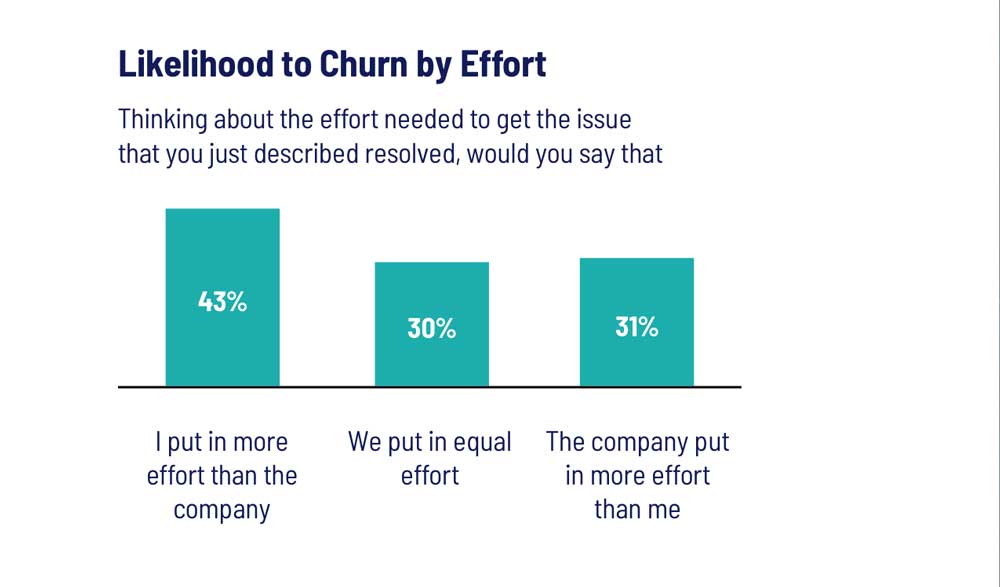
Among those customers who believe they put more effort into resolving an issue than the company, 43% indicate a likelihood of switching provider. This compares with 30% when both parties contribute equal effort and 31% when the company contributes more.
The lesson is straightforward: resolving a problem is important, but demonstrating responsibility, empathy and commitment to the customer can be equally important.
Indeed, service “recovery” and retention may represent one of the most overlooked opportunities for brands to strengthen customer relationships.
A new agenda for marketers
Ipsos B&A warns that the findings of the research are “a vital reality check.”
“With many households struggling and most finding budgets are getting tighter, customers are seeing pricing and value for money as more important than ever,” the research team suggests.
“At the same time, faced with rising costs and growing customer expectations many brands are turning to AI and automation to improve efficiency. As a result, customers are finding less delight in their interactions with brands, which are in many cases becoming less personal and less tailored, with AI implementation.
“As always, customer experience becomes the key differentiator. Brands that rise above mediocrity will stand out. Our recommendation is that brands should be redefining their CX strategy and VoC programme to drive customer engagement, loyalty and advocacy.”
The report argues that brands can break this cycle by identifying opportunities to create small, meaningful moments of recognition, empathy and delight. Organisations need to ask not just how experiences can be made easier, but more memorable. Organisations are encouraged to identify the moments in the customer journey when customers can feel recognised, valued or pleasantly surprised and put effort here.
The rule of thumb for Ipsos B&A is to deploy AI where it creates convenience speed and personalisation and invest human effort in the areas where customer needs reassurance , empathy, judgment or emotional connection.
In addition, giving frontline employees greater freedom to solve problems, communicating proactively when something goes wrong and recognising loyal customers can all contribute to stronger emotional relationships.
For marketers, the broader implication is that CX can no longer be treated as an operational responsibility sitting outside the marketing function. Indeed, it is an integral part of brand building, customer retention and long-term profitability.
The research also challenges the assumption that technological sophistication automatically creates competitive advantage. Ipsos B&A says that if every brand adopts similar technologies, automation may simply become another category standard.
The real opportunity lies in how technology is used to deliver experiences that customers value, it says.
As Ipsos B&A concludes, the age of beige is not inevitable.
For Irish brands willing to invest in emotional connection as seriously as operational efficiency, customer experience offers a potentially powerful route to differentiation and sustainable growth.
And in an increasingly automated marketplace, the most effective competitive advantage for brands may ultimately be something that is, well, distinctly human.