
















 Pitch-side advertising has moved far beyond painted boards to become dynamic channels that blend brand building with measurable performance, writes Gareth Irvine.
It was a cold Friday morning at Ravenhill, Ulster Rugby HQ, over two decades ago. I was there as the client to oversee the installation of an innovative “try line takeover” for ntl. The concept broke from the traditional single-board format, using 12 consecutive boards to maximise brand impact. At the time, ntl was launching “fibre broadband” to the “narrowband” audience across the UK and Ireland, supported by sponsorships spanning Celtic, Rangers, Newcastle, Aston Villa, and the Lions tour of Australia.
Back then, pitch-side advertising was simple. Wooden boards, hand-painted with local sponsors including insurance brokers, car dealerships, builders’ merchants and the long-time shirt sponsor Bank of Ireland.
At venues like Lansdowne Road, these static signs were often faded and interchangeable depending on the event. Their purpose was clear: drive awareness through repetition. If your brand sat behind the posts, you were visible. Nothing more, nothing less. A single board at a Five Nations match could cost 10,000 punts, delivering one outcome: brand recall.
From these humble beginnings, pitch-side advertising has evolved into one of the most advanced media channels in sport.
The Digital Shift: From Static to Dynamic
The late 1990s and early 2000s marked a turning point with the introduction of LED perimeter boards. Competitions like the Premier League and UEFA Champions League led adoption, transforming static signage into dynamic, rotating inventory.
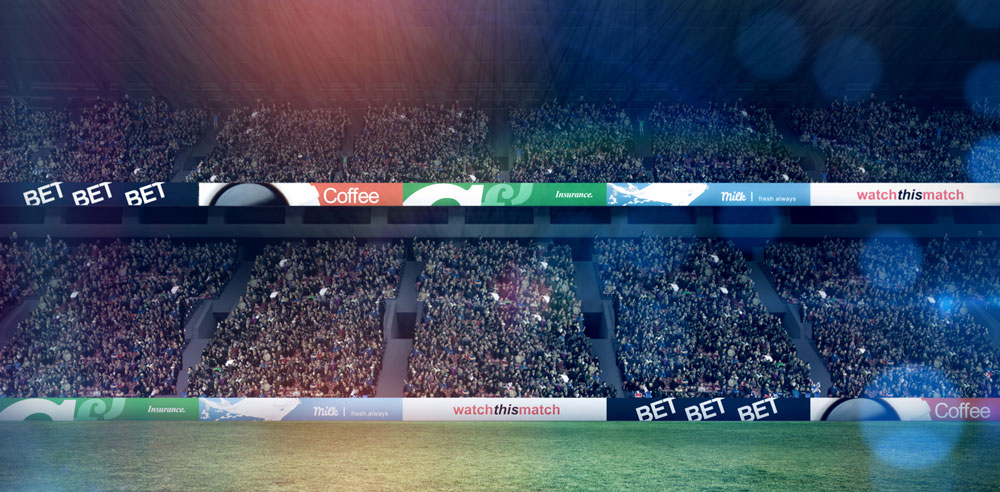
Instead of one advertiser per board, per match, multiple brands could rotate messaging. The concept of a digital signage take-over “Ribbon” dramatically increased commercial inventory and allowed clubs and rights holders to attribute and monetise pitch side real estate at scale. Early adopter clubs included Manchester United and Arsenal as they quickly recognised the broadcast and sponsorship added value. In rugby, similar transitions occurred at venues like the Aviva Stadium when it opened in 2010. The introduction of digital signage in Croke Park in 2004 was reported in the Irish Times as facilitating a +40% increase in signage revenue for the GAA.
While the early digital era increased volume, the creative was still largely rooted in traditional brand advertising, logos, slogans, and static creative adapted for digital screens. It was not long before brands like Vitality in the UK, tested the impact of visual disruption with “Stanley” their distinctive brand asset sausage dog, walking across their ads. Not long after, this inspiration delivered airline creative with taking off planes, bouncing footballs and numerous 3D illusions. A truly disruptive “fit for format and fit for objective” evolution was embraced.
Creativity Evolves: Branding Meets Performance
The next major shift came in how brands used the medium. While traditional brand advertising remains important, pitch-side is now increasingly performance-driven.
Modern pitch side ads often include direct response calls to action such as “Download Now”, “Bet Live”, “Reserve Now”, “Now Available” and other CTA prompts. Time-sensitive offers tied to live match events also appeared. Minimum channel alignment became consistent messaging, imagery and call to actions, those that are replicated across multi-channel media plans, especially in “2nd screen social”.
The Rise of Takeovers: Owning the Moment
A defining recent trend is the shift toward full-perimeter takeovers. Instead of multiple advertisers sharing space, a single brand dominates all boards for a short, high-impact window. Premium inventory is now also defined around key moments like penalties or conversions.
This reflects a broader truth: in a cluttered media landscape, impact often outweighs frequency. A single, immersive moment, especially one replayed repeatedly post game, can deliver greater value than multiple fragmented exposures. As global events like the FIFA World Cup continue to evolve, this premium inventory will only become more strategically important. We will see this especially during penalty shoot outs this summer.
Engineering Impact: Double-Stacked Displays
Innovation hasn’t stopped at content. The physical format itself has evolved with the introduction of double-stacked LED boards. Two aligned layers that merge into a single, taller canvas on broadcast.
First pioneered by Wolverhampton Wanderers in 2018, and later expanded by Manchester City, this format enables “supersized” creative executions that feel almost augmented in nature. Campaigns can span both layers, creating a more immersive visual experience for viewers.
However, this comes with trade-offs. Sightline challenges for fans, increased production costs, and concerns about visual dominance have sparked debate. As with any innovation, balancing commercial value with fan and viewer experience remains critical.
Virtual Advertising: Breaking Physical Limits
Perhaps the most transformative development is virtual advertising. Using advanced broadcast technology, pitch-side ads can now be replaced or augmented in real time for different audiences.
A viewer in Ireland might see one brand, while a viewer in the UK sees another, both during the same live match. Many ads will not even exist physically in the stadium, decoupling commercial value from physical presence entirely.
This opens the door to unprecedented localisation, with brands tailoring messaging by geography, language, and audience segment. As global tournaments expand their reach, this capability will become central to maximising relevance and ROI.
From Visibility to Precision
Pitch-side advertising has moved far beyond painted boards and passive visibility. It is now a sophisticated, data-enabled, creatively dynamic channel that blends brand building with measurable performance.
What began as a game of presence is now a game of precision.
The future will be defined by integration between physical and virtual, brand and performance, global scale and local relevance. Success will depend not just on being seen, but on being meaningful and relevant in those sporting moments that matter most.
In a world where every second of attention counts, pitch-side advertising is no longer just part of the game. It is a strategic platform shaping how brands connect with the most loyal of audiences in real time. They may now be called pitch side advertising units but for me they will always be boards or hoardings. Some things never change. Play on….
Gareth is Digital & Media Director at OLIVER, The agency delivers pitch side advertising at Old Trafford for Malta Tourism Authority and in the AVIVA Stadium and the RDS for Bank of Ireland. OLIVER produced Britvic ads are also regularly pitch side in Croke Park and the AVIVA. Internationally locally produced creative has recently run pitch side at Inter Milan and LA Galaxy.