
















 James Byrne, Marketing Manager, PML Group, with this week’s Out \ Look on Out of Home
As AI-powered search and answer engines reduce clicks and reshape online discovery, brands face a new challenge: how to build trust before consumers ever visit a website. These technologies are accelerating a broader shift toward ‘zero-click’ information experiences, reducing referral traffic for many publishers and reshaping how users interact with search. In this environment, Out of Home advertising has an increasingly important role to play.
As AI fills screens with content difficult to verify, emerging research suggests consumers increasingly place greater trust in experiences they can observe and verify in the real world. Answer engines don’t create demand. They organise and recommend among existing choices. That means brands still need to build familiarity and preference before consumers initiate a search. In this context, we feel that OOH, as a real-world medium, is perfectly positioned to reach people in physical, public spaces as they go about their everyday lives. And at PML Group we have a deep understanding of what people think, feel and do and how they live, work and play in the out of the home space.
Why Real-World Presence Matters More Than Ever
Firstly, we look at how OOH is perceived and trusted by the public. Kantar’s IRL Advantage study highlights the growing importance of physical media in an increasingly automated and AI-driven environment.
The research found that 64% of consumers believe brands seen in public spaces feel more like part of real life, while 37% see that presence as evidence the brand is legitimate. When OOH appears alongside online or television advertising, 74% perceive the brand as more trustworthy and credible.
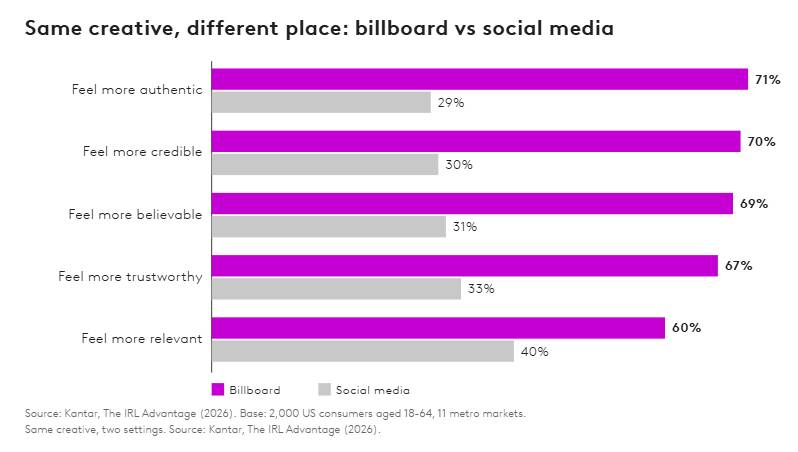
These findings point towards an important distinction.
AI can generate content instantly. It can produce recommendations, summaries and comparisons at scale. What it cannot replicate is a physical presence in the real world.
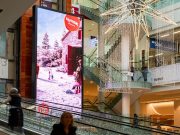
A billboard on a commuter route, a digital screen in a shopping centre, a transport campaign seen repeatedly during the working week or a branded experience in a public space all demonstrate something tangible: the brand has chosen to show up.
That visibility signals investment, confidence and permanence.
OOH builds visibility and trust
Many consumers associate a visible public presence with investment, scale and commitment. The simple act of being present can therefore communicate legitimacy in a way that digital impressions alone may struggle to achieve.
Physical and Out of Home environments create tangible moments between people, communities, and brands, shifting focus from simple digital reach to genuine confidence and credibility.
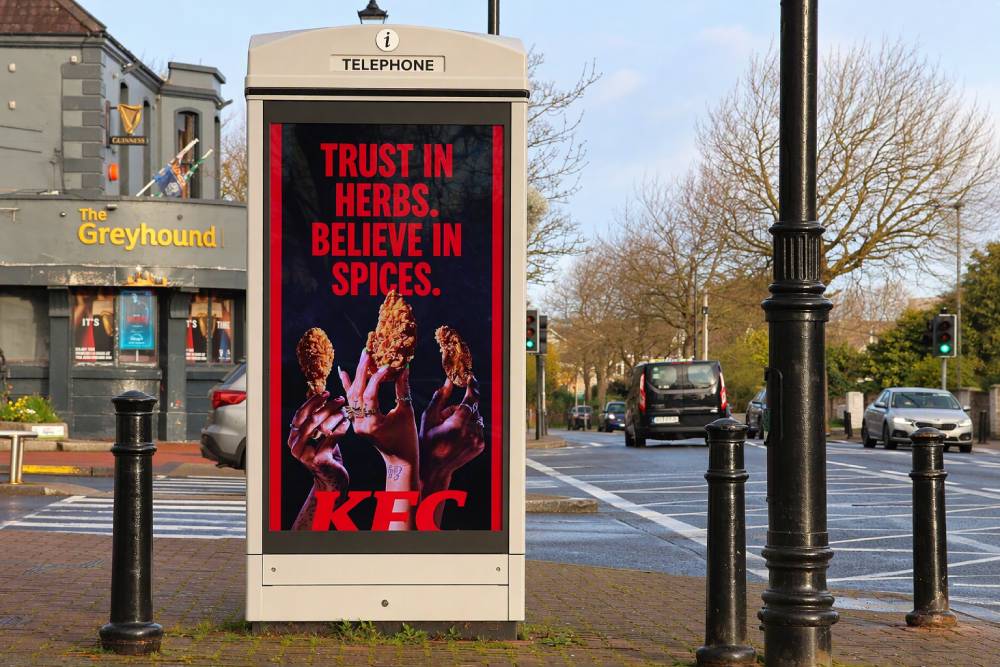
The physical layer is the part of a brand’s media architecture that people can see, experience, and verify in the real world. This includes Out of Home ads on the street as well as in travel and retail environments, along with interactive brand experiences such as pop-up events. When asked what it says about a brand when it advertises in a public place, consumers’ top three responses were:
- It has the confidence to be seen, and judged, by everyone (41%).
- It’s established: a brand that’s legitimate, not a flash in the pan (39%).
- It’s committed to being a part of the real world (38%).
Kantar then identified four priorities when finalising next year’s budgets:
Treat OOH as a trust builder. Evaluate it on its contribution to brand trust and to the performance of your digital activity, alongside the impressions it delivers.
Prioritise it for audiences under 45. Three in four Gen Z and Millennials say they’re paying more attention to ads in public spaces, compared with 56% of Gen X.
Invest in experiences. Interactive formats outperformed every other channel on trust and credibility.
Review your plan for trust gaps. If most of your impressions sit in feeds, you’re building reach in the environments consumers trust least.
Out of Home also impacts consideration. New research from the Out of Home Advertising Association of America (OAAA), conducted in partnership with The Harris Poll, shows how engaging consumers in the real world can influence behaviour from initial brand discovery through purchase.
Nearly three-quarters (73%) of adults say they prefer products or retailers that engage them through in-person experiences or local outdoor events. Sixty-nine percent say Out of Home advertising feels more human than online or mobile advertising, while 64% say it feels more culturally relevant.
The impact of real-world engagement does not end with the initial encounter. Following a memorable live brand experience, 30% of consumers searched for more information later, 30% looked for the product in stores, 30% viewed the brand or retailer more positively and 27% purchased the product later.
That influence continues as consumers get closer to a purchase decision. Seventy-seven percent of adults ages 18-64 recall recently seeing retail OOH advertising, rising to 81% among Gen Z.
Half (50%) of consumers say retail OOH impacts their purchase decisions when encountered in the days before shopping. That rises to 59% immediately outside a store and 64% inside the retail environment, demonstrating how OOH can influence decisions as consumers move from consideration toward purchase.
Taken together, the research shows the power of OOH throughout the consumer journey: capturing attention, building memory and consideration, extending engagement across channels and driving action through purchase.
So real-life experiences are what consumers trust and what they value most. Brands that recognise this can gain a competitive advantage over those that don’t. The implications of search also extend to out of home environments where triggers and resulting actions are distinct.
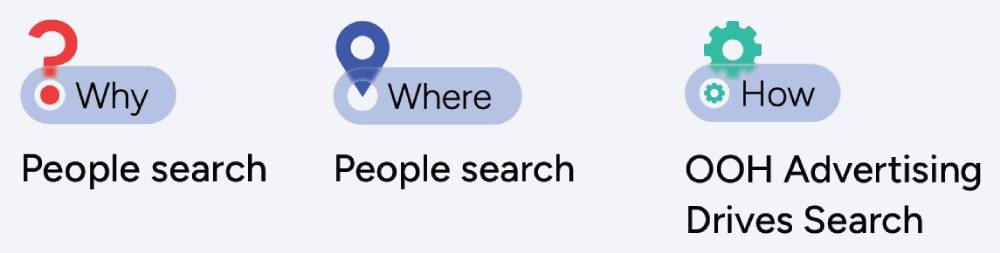
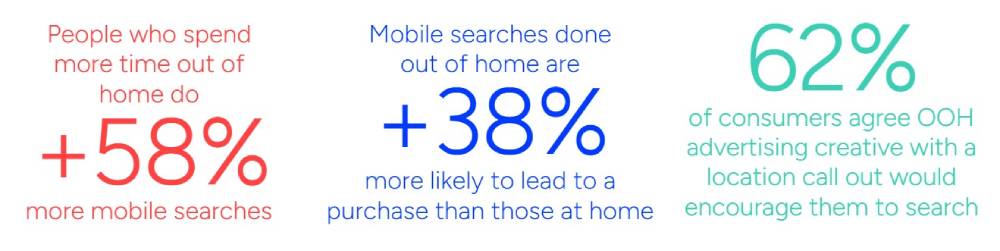
The Point of Search research, commissioned by Posterscope, Clear Channel, Global and JCDecaux, found that mobile searches conducted out of home are more diverse than at home mobile searches and lead to more actions. Mobile searches conducted out of home are 38% more likely to lead to a purchase.
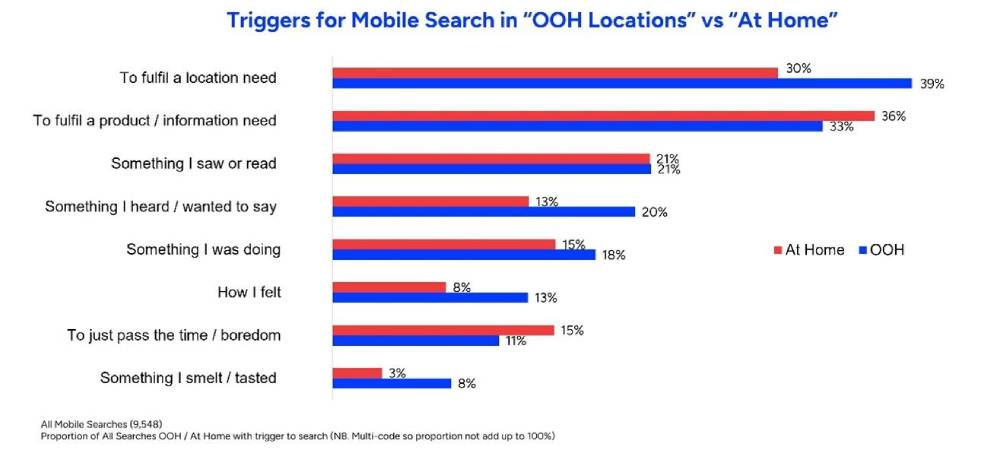
Searches out of home have a wider variety of triggers, particularly location needs, the senses, and feelings. They are also more spread out across time periods (over 8 in 10 taking place between the morning and 7pm), while 4 in 10 searches at home take place in the evening post 7pm. OOH advertising creative can be optimised by tailoring messages to needs and motivations, using specific creative messages, elements and Dynamic DOOH.
The study highlights the fact that search behaviour is a clear indicator of consumer needs and as a result, creative messages can be linked to these needs, and the optimisation of specific creative elements such as large logos, short succinct copy and large product shots can have a significant impact on search behaviour. DOOH incorporating Dynamic contextually relevant messages, such as location, weather and time also encourages people to search.
Closer to home, the autumn 2026 data release of the Republic of Ireland TGI survey finds that nearly half of adults nationally have acted in response to seeing any type of Out of Home advertising, either at the time or later on. For OOH consumers this increases to 63%.
The Opportunity for Irish Advertisers
Physical presence is more than visibility. It creates community and shared cultural connection. In an increasingly frictionless digital environment, the effort required to show up physically can itself become meaningful.
As consumers gain new ways to research and choose, brands still need to be familiar, relevant and credible. OOH can help build those qualities before the consumer opens a search engine or asks an assistant.
Advertising builds familiarity. It introduces products, creates curiosity and helps brands come to mind when a buying situation arises. That gives Out of Home an important role as discovery changes. Before consumers ask for advice, OOH can help put a brand into their consideration set.
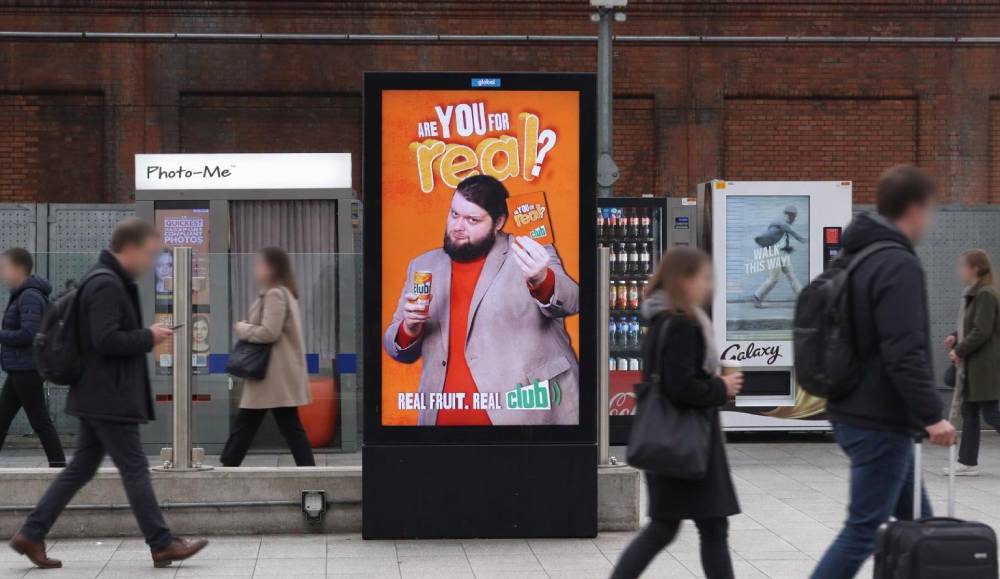
Out of Home plays by different rules. A poster on a commuter route can’t be blocked or scrolled past. It lives in the physical world people move through every day, and it asks nothing of them, not even a click. For brands building familiarity over time, that kind of presence is very hard to recreate on a phone screen.
At PML Group, we believe the most successful brands in the answer engine era will be those that combine strong digital information with strong real-world presence. Visibility creates familiarity. Familiarity creates trust. Trust shapes consideration.
And consideration often begins long before the first search.
Because the brands most likely to appear in people’s decisions tomorrow are often the brands they notice today.