















AdWorld Features 

Bookmark and Share RSS Feed

Control What You Can Control

As part of the annual Advertising Agency Issue IMJ spoke to Orlaith Blayney, managing director of McCann Erickson Dublin about how adland is dealing with the collapse in marketing budgets.

How would you sum up the past year in business?

Somewhere between challenging and crippling, it's been a tough, tough 12 months.

The market is down 20% according to IAPI figures but that's not a real reflection in the decline of ad spend because you can't see the level of discounting going on. IAPI quotes rate card. So it's probably closer to 35% decline in ad spend. Press has taken a real hammering. RTE is down €35 million and if you annualise this the figure hurtles towards €65-70 million. Obviously they fixed their price now so it helps them slightly protect that. Radio remains reasonably resilient, because it's cost effective and flexible for advertisers.

How do you feel about RTE's decision to put a floor on ad rates?

They had no option as a business but to do it. They had to stabilise the market. Obviously it hasn't been very popular with clients who were taking advantage of it. The upside for media agencies is that they can plan now and plan once as opposed to planning every time the price changed, so it does give a certain stability.

Did you believe the recession would bite this deep and affect media spend so much?

No. I think the biggest issue for Irish agencies and communications businesses is the degree to which the downturn is beyond our control. Decisions are been taken outside this market, and because of the sterling weakness some brands have cut marketing to the Irish market, which is a small market of 4.5 million people. Returns for any of the big brands here are reasonably small in the context of global decision making. A lot of the factors affecting agencies are out of our control.

How are the big brands reacting in this climate?

In order to get cost synergies many global brands centralise their advertising production. The growth over the past few years was in local production on global brands and that's been affected now. There is still evidence to suggest that global ads are hit and miss. Local strategies work better.

The split between media and production costs is also a factor. Our ratios here are hard to defend if a global brand looks at them. We're a small player in the global sense and brands and businesses have been forced to take a look at all their synergies to protect their businesses.

Are we still within the spiral of falling consumer confidence?

Consumer confidence is still down. The US is showing a bit of an uplift, but we don't have the Obama factor and leadership in this market is sadly lacking. There's no real credible alternative. There's a striking lack of leadership.

Do you think there are enough great ideas in adland or are campaigns more about execution and technique rather than ideas?

There are lots of ideas but making stuff happen is the most difficult thing. Procrastination is the biggest issue in Irish business and now it's combined with fear. There is an over supply of execution and a lack of big ideas, it's back to the leadership issue. Having a big idea and having vision is also lacking in client companies. Things are happening so fast they force you into making fast decisions. We have a mantra "Think harder, act faster".

People should take more time over strategic planning for their businesses and brands, but we're all been pushed into this quick, fast mind set.

Some say the client is often left out of the advertising process. Is this true in most cases? Is it changing?

The best campaigns are down to client/agency collaboration. We're blessed we have collaborative clients who work with us. There's no up side to leaving clients out. If clients feel left out tensions can arise. Agencies often say clients aren't courageous, but the problem is marketing directors often don't get rewarded for taking risks.

Some smaller agencies recently won some big business (from bigger agencies). Is this a trend we see emerging?

At end of day, it's a bit like Tesco and Prada. Big agencies will argue they have the best talent, processes and execution. They know how to do stuff but the reality is they've got the overheads to fund that model.

Is it a trend? I think more of a trend will be with the rosters, so that if you win an account you don't get everything, like Diageo's brands - they are rostered to different agencies.

Is cost now the main factor when a client chooses an agency?

I've never been at a pitch where the real reason you didn't win was you were too expensive. If a client wants an agency, cost is not the deciding factor. There's a saying ‘Fast, cheap, good - pick two'. If an agency is really cheap they're probably not that good. If the client wants you and your team everything is negotiable.

Are clients demanding greater transparency on timesheets, all estimates and invoices?

I think integrity is one of the biggest issues in this industry and we are 100% transparent, all our books are open to audit.

Unfortunately if you are taking rebates and kickbacks from suppliers to keep your business open you don't have a business. Commission on media volume rebates from media owners served no one's interest and that model is fundamentally flawed.

Are clients going direct more?

There's always an opportunity for clients to get cheaper prices and media owners will take the ads and undercut the agency, we know what goes on. If clients have the time and energy to chase their own deals of course they can get better value.

The problem with the commission system and rebate system in media is it's not based on anything. If I'm given a big incentive to put money with a certain TV station or radio station, given the client's objective, that might not be the right thing for the brand. It's totally flawed as a strategy when you decide the media schedule based on kick backs.

Is it now time for a re-think on the proposed legislation that will stifle food and drink advertising?

There are lots of proposals on the table, all clients are extremely aware of the possibilities and are looking at reformulations. Advertising is about looking for share of market, it's about brand choice. It's not about influencing people to eat lots of sugary food or drink too much alcohol. Even with restrictions there will still be ways to compete but what kind of media landscape will be left behind if they ban or restrict food and drink ads?

What do you honestly feel about social networking trends (like Twitter, Facebook, YouTube). Are they distractions with no real possibility for advertisers or do they contain opportunities?

There are still only 4.5 million people in this market so the scope and effect of social networking still has limitations. It's great for buzz, but the market here is small and the challenge is how to make it pay. How can we prove the return on investment? The cost of minding and keeping in touch with consumers on social networks is huge, what you create is expensive and time consuming. Social networking can have limited impact and I haven't heard about any Irish campaigns that were hugely successful on social networks.

Good online advertising is still about creativity. But how measurable is it in terms of acquisitions?

There will always be something new in the social media space. There's no getting away from the importance and future influence of digital media the challenge is how do you drive sales of your product online.

Where's Second Life now, there was so much hype around it? I'm a big supporter of TV, a really strong piece of

What are the most important things to consider, as an agency, facing into the next year?

Number one is your costs, what kind of costs structure are you going to have as a business? What agency make up and resources do you need to be viable? This years it's survival mode for most agencies in the market.

The second biggest question the bigger integrated agencies will ask themselves is how do we make digital pay. It's very labour intensive and how do we offer and structure digital that clients can see results from. No one's really cracked it in terms of a traditional agency with digital at the heart of it. Some will argue they are doing it but its how they are seen by clients.

What will adland look like this time next year?

There will be less agencies around. Big agencies are finding it tough. Many are 20-40% down on revenues depending on the mix they have. That's a reality. No one is immune from the business climate nationally and internationally.

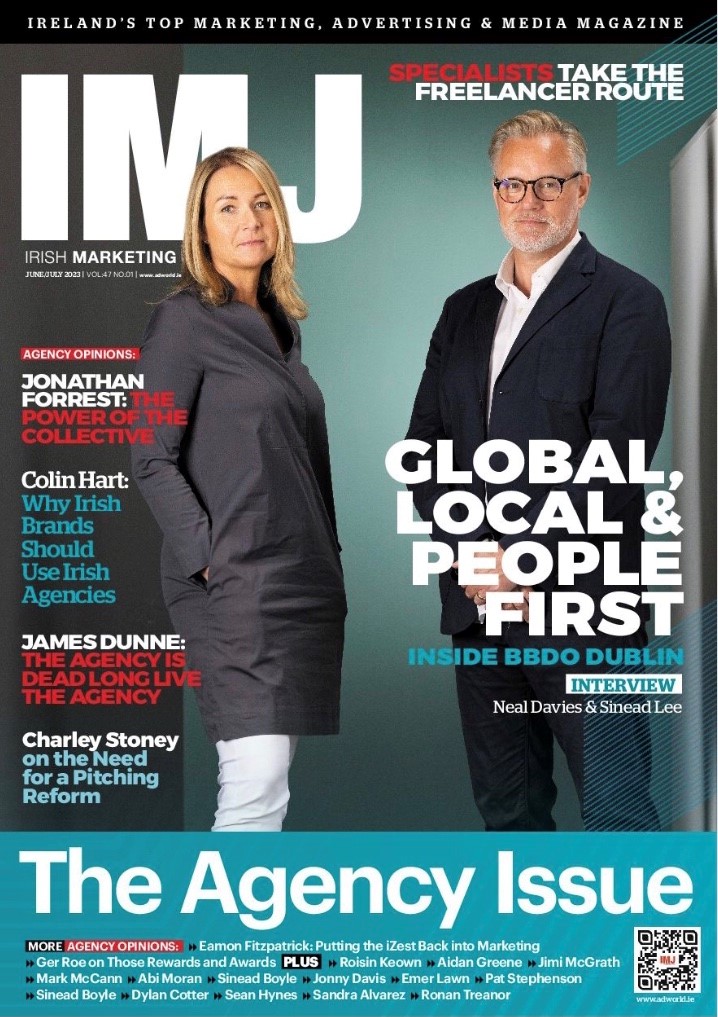
 This article appeared in IMJ's annual Agency Issue. To view a digital issue of IMJ click here


Comments

Submit a Comment

Submit

© Mount Media Ltd. Material may not be republished without permission.