
















 “With AI already making significant inroads into the advertising and media industry, one Irish company is banking on a big uptake in its services as advertisers start to look for new solutions, writes John McGee.
In the cut-throat world of media buying, disruption is everywhere and with artificial intelligence now a key tool in day-to-day operations, it is facing its biggest period of upheaval since programmatic advertising.
As AI rapidly dismantles many of the manual processes that have underpinned media planning and buying for decades, from audience analysis and channel selection to campaign optimisation and reporting, tasks that once required teams of planners, buyers and analysts can increasingly, can now be completed in seconds by AI-powered systems capable of processing vast quantities of data, identifying patterns and making recommendations at a scale no human team could match.
For the advertising industry, the implications are profound. As marketers demand greater accountability, faster decision-making and improved return on investment, AI is beginning to challenge traditional agency structures and established ways of working.
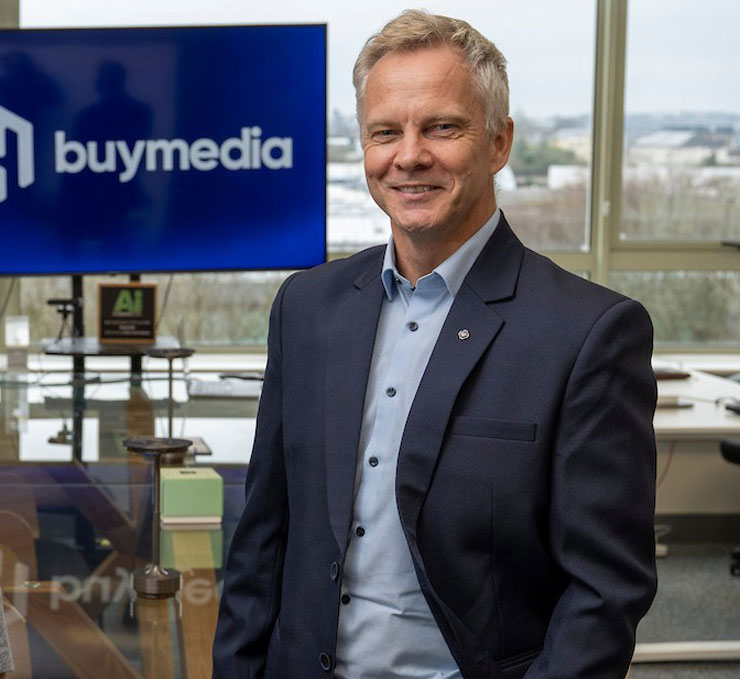
One company that is hoping to surf this AI wave is Buymedia, the Galway head-quartered company that was formed by Fergal O’Connor in 2015 with a view to shaking up some of the more arcane media buying practices that existed at the time.
With an advertising sales background in print, broadcast and digital, O’Connor saw that the old model of media buying was broken, particularly for smaller advertisers that did not have the luxury of dealing with one of the larger media agencies.
“When I set up the business, it seemed to me at the time that the marketplace was broken. Businesses didn’t seem to have any real insight into what media channel was right for their customers or where they should be placing their advertising,” says O’Connor.
“It didn’t seem like an effective market if the people buying media didn’t have the information they needed to make informed decisions,” he adds.
“Media was very much like banking or travel before the internet. That’s just the way it worked. If you wanted to advertise in a newspaper or on a radio station, the media company came out and sold it to you directly. That was simply how the market operated.
While access to different media channels was not a problem, O’Connor felt that “understanding which media channels were actually right for a particular audience” was a bigger issue that needed to be addressed.
It was with this in mind that O’Connor decided to tackle what was an information and data deficit for advertisers.
“Initially I thought the solution was to build a marketplace for small, medium enterprises where they could go and have access to all the different types of media whether it was print, radio, social or digital so they could go and make their own informed decisions. And when we did that, we realized that wasn’t the problem at all. It’s not the problem. Isn’t availability or being able to see all the media options. The real problem was trying to figure out the ideal customer profile or the people that the advertiser is trying to reach and what media they should be using,” O’ Connor adds.
“So, the eventual solution that we arrived at was a platform or a solution that could build an AI persona, or digital twin, of the ideal customer for that business, organization, charity, or whatever. To do this, required data, lots of it. So, we needed to build the data piece into all of this and that’s where AI started to come in.
“We also realized that we needed to build algorithms and machine learning into the system that could take this profile and then match it against all the different media types. So that was the second iteration. And then from that, we needed to be able to execute the campaign and then send all the ad copy to the different media companies. Then we needed to be able to report on all the campaigns and work out what was working and what wasn’t.”
Many of these processes were automated, he says, and Buymedia was able to build generative AI media plans for clients.
“We were also able to build out AI strategists. So, like you have a cohort of people you’re trying to target, we use the AI to then question that cohort and get more insights into that customer, before we go into doing the marketing to that customer. And then finally, we looked at the learning piece. How can we use AI and predictive analytics to actually look at the KPIs in the business and figure out what media is driving those KPIs? With that information, we can deliver clear feedback, recommendations and insights to the persona, the business and the marketing team,”. O’Connor says.
“The real goal is to help businesses plan, purchase, execute, manage and learn from their advertising,” he says.
O’Connor is keen to distance the company from being perceived as a media agency or for that matter just another ad-tech company. “We are a tech business that uses AI to help advertisers get the most out of their budgets by using quality data and KPIs to inform their decision making.”
He adds: “In Ireland we largely went direct to brands. In the UK we’ve seen something different — independent agencies view the platform as a way to make their businesses more efficient and more effective. So, we are finding that we are not necessarily replacing agencies but that in many cases we are helping them operate more efficiently.”
Since 2015, the company has grown considerably and now employs 20 people between Dublin, Galway and Manchester. Its client roster includes brands such as eir, E45, Bio-Oil, JYSK and Bluebird Care.
Along the way it received support from Enterprise Ireland and then moved on to the National Digital Research Centre’s accelerator programme. Such was its growth that the company was listed in 73rd place of the Deloitte’s EMEA Technology Fast 500 in 2023, with revenue growth of 2,208%.
Recently it announced that it is to invest £1.5m in the business as part of a new expansion into Northern Ireland with a new office in Belfast’s Ormeau Labs. O’Connor adds that he would like to explore the US and Canadian markets next.
“I’d like us to be more international. We’ve obviously have a decent foothold in Ireland and we are just starting on our journey in the UK. So, over time, I’d like us to develop a substantial business in the UK and I’d like to see us have some sort of presence in either the US, Canada or potentially Australia, so the English speaking markets. This will be a proving point for us as we believe we can have a global impact and that we have a solution to a global problem.”