















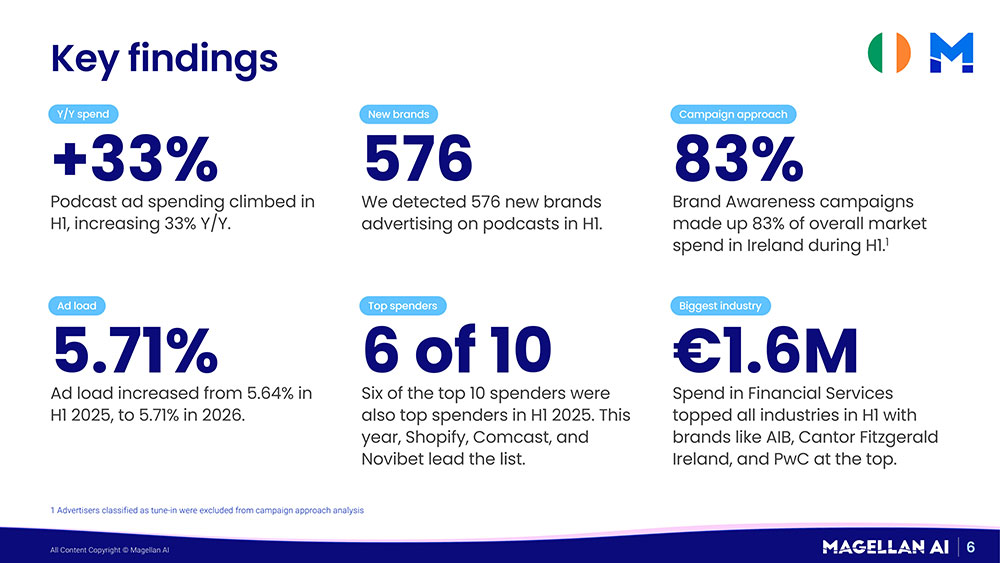
 Podcast advertising expenditure in Ireland rose by 33% year-on-year in the first half of 2026, according to new data from Magellan AI, underlining the medium’s growing appeal to major advertisers and a widening pool of brands.
The company’s first H1 2026 Ireland Podcast Advertising Benchmark Report found that 576 new brands advertised on podcasts during the six-month period. At the same time, brand-awareness campaigns continued to dominate the market, accounting for 83% of estimated spend, while direct-response advertising accounted for 17%.
The survey came about after digital audio company AudioOne approached Magellan AI about replicating its other international surveys in the Irish market. Magellan AI’s wider measurement operation samples more than 60,000 podcasts across Ireland, the UK, US, Canada, Germany, France, Spain and Australia.
 “When advertisers can see what’s working, they invest with more conviction,” said Cameron Hendrix (left), co-founder and CEO of Magellan AI. “This report brings that visibility to podcast advertising in Ireland for the first time.”
As part of the roll-out of its first Irish survey, Magellan’s data team mapped podcast advertising across popular Irish shows in the first half of 2026 and compared it with the same period in 2025. Magellan indexed ads running on most of the largest podcast networks and shows in Ireland including Acast, AudioXI, Mediahuis, HeadStuff, RTE, Global, RTE, Spotify and others.
Magellan’s models see both the brands buying the ads and the shows carrying them, listening across thousands of podcast episodes to detect each ad and the spend behind it.
The figures point to a market that is becoming more established rather than simply more experimental. Six of the 10 largest podcast advertisers in Ireland during H1 2026 were also among the top spenders a year earlier, suggesting that some large advertisers are now treating podcasting as a recurring rather than occasional part of their media plans.
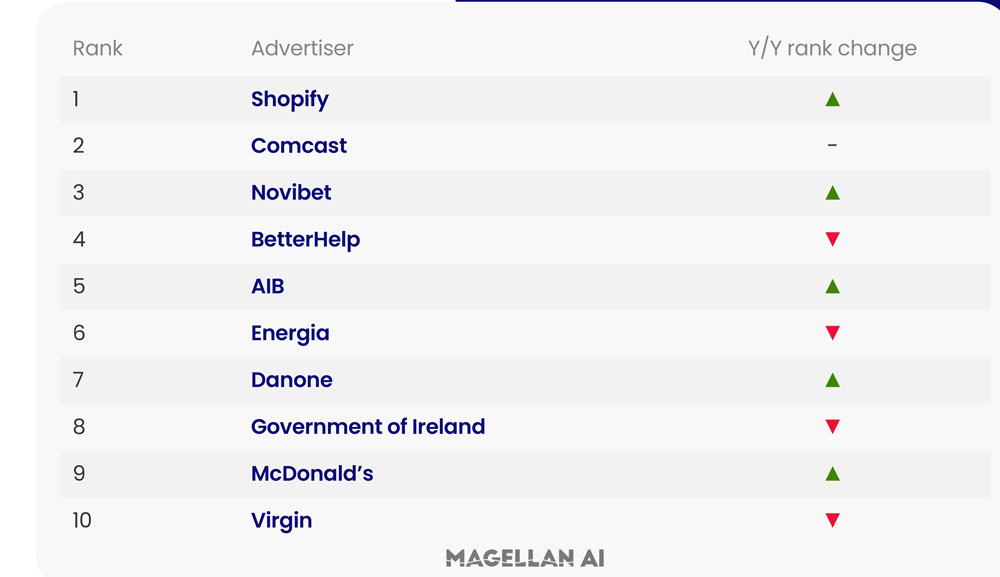
Shopify was the biggest spender during the first half, followed by Comcast and Novibet. BetterHelp ranked fourth, while AIB, Energia, Danone, the Government of Ireland, McDonald’s and Virgin completed the top 10. Shopify, Novibet, AIB, Danone and McDonald’s moved up the rankings, while BetterHelp, Energia, the Government of Ireland and Virgin moved down.
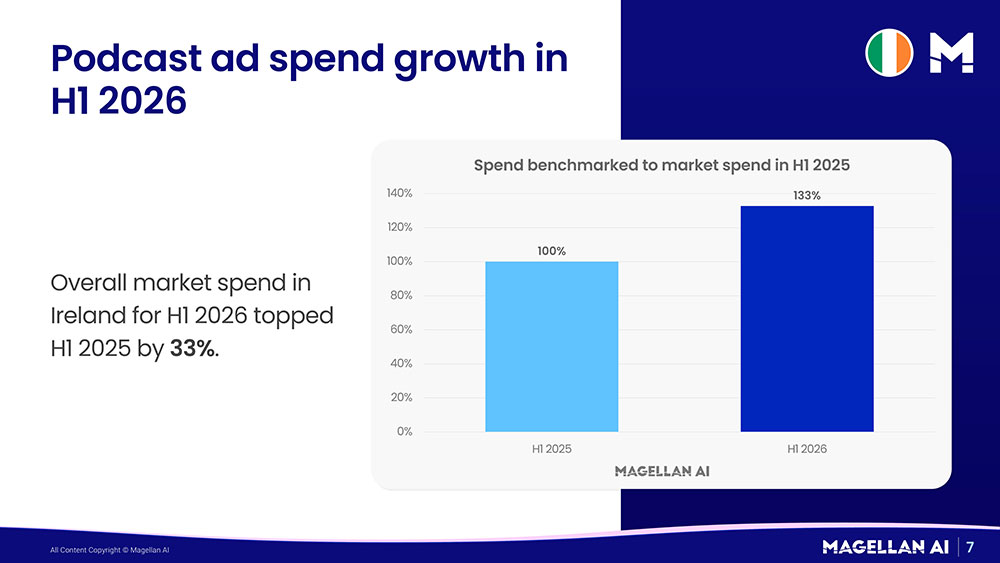
The growth in expenditure has been substantial. Magellan AI benchmarked H1 2025 market spending at 100%, compared with 133% for the same period this year. In other words, the Irish podcast advertising market expanded by about one-third in 12 months. It is estimated that by the end of 2026, the Irish market will be worth around €28m.
Financial services was the largest category by estimated spend, at €1.64m. Food followed at €1.27m, while phone, internet and cable companies accounted for €1.17m. Business services and software were the next biggest category with an estimated spend of €880,000, with energy accounting for €850,000. Among the financial-services advertisers highlighted in the report were AIB, Cantor Fitzgerald Ireland and PwC.
The mix is significant because it shows podcast advertising extending across a comparatively broad range of mainstream categories. Banks, food businesses, telecommunications companies, utilities, technology brands and public-sector advertisers are all represented among either the leading categories or biggest advertisers.
A key finding of the Magellan AI report is the dominance of brand advertising. Brand-awareness campaigns accounted for 83% of market spending during H1, compared with 17% for direct response, with the respective shares unchanged from H1 2025. Advertisers classified as “tune-in” were excluded from this analysis.
The figures suggest podcasting’s role for advertisers is no longer confined to generating immediately measurable responses through promotional codes and dedicated URLs. Instead, much of the money tracked by Magellan AI is being used for broader brand-building purposes.
Advertising loads, meanwhile, have barely changed. The average share of podcast episodes devoted to advertising increased only marginally, from 5.64% during H1 2025 to 5.71% this year.
That is potentially an encouraging development for publishers. A 33% increase in expenditure accompanied by an increase of just 0.07 percentage points in advertising load indicates that rapid revenue growth has not been matched by anything approaching the same increase in the proportion of programme time devoted to commercials. It points instead towards stronger advertiser demand and greater monetisation of existing inventory.
Mid-roll remains the favoured position, accounting for 46% of all ads detected in Ireland, followed by pre-roll at 37% and post-roll at 17%. Thirty-second ads were the most common length, accounting for 32% of detected advertising. Fifteen-second ads represented 15% and 60-second spots 14%. Longer executions were less common, with 90-second ads at 4% and 120-second ads at 1%.
The findings do, however, come with methodological qualifications. Magellan AI analyses advertising from thousands of episodes of popular Irish podcasts and says it has incrementally expanded its coverage of Irish shows throughout 2025 and 2026. It also samples multiple copies of certain episodes to capture dynamically inserted advertising.
Its spending figures, however, are estimates rather than audited industry totals. Its proprietary model considers the number of advertisements detected, estimated episode downloads, CPMs drawn from selected media kits or estimated according to popularity, the type of advertisement and whether inventory was bought directly, programmatically or through run-
The Irish figures should therefore be regarded as a benchmark and directional measure rather than a definitive valuation of the entire sector. Nevertheless, the direction is clear: spending is increasing rapidly, hundreds of new advertisers are entering the medium and established brands are returning. Indeed, industry analysts value the digital audio market at around €28m this year.

“Advertisers and agencies have been asking for proper benchmarks, and Ireland finally has the data,” said Dermot O’ Reilly (above), co-founder and director of AudioOne. “This is a real milestone for our podcast industry, and a sign of how far the channel has come.”